
Why Bitcoin Holders Are Using Sealed Bids to Acquire Private Planes
Understanding the Private Aircraft Market
The private aviation market operates differently from almost any other luxury asset category. Aircraft transactions involve federal registration, mandatory inspections, complex maintenance histories, and substantial ongoing operational costs. These factors make private aircraft acquisition fundamentally different from buying art, real estate, or even yachts.
The Traditional Aircraft Transaction Process
Historically, private aircraft sales follow a lengthy, opaque process:
- Buyer identifies aircraft through broker or direct contact
- Initial price negotiation (often taking weeks)
- Pre-purchase inspection scheduled (1-2 weeks)
- Price renegotiation based on inspection findings
- Title search and FAA registration review
- Escrow period (2-4 weeks)
- Closing and transfer
This process typically takes 60-90 days and involves extensive back-and-forth negotiation. The final transaction price is rarely the initial asking price, and the buyer often has limited visibility into whether they’re paying fair market value or whether other interested buyers exist.
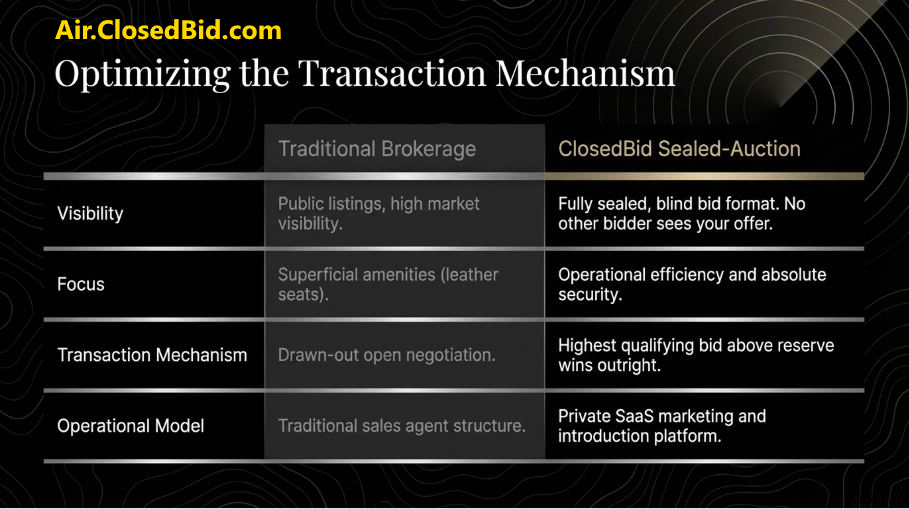
How Sealed-Bid Auctions Change This
A sealed-bid auction compresses uncertainty and creates price discovery transparency:
- Aircraft is listed with complete specifications, maintenance records, and inspection reports
- Multiple qualified buyers submit confidential bids
- Highest qualified bidder wins at their submitted price
- Pre-purchase inspection is completed before bidding (inspection reports available to all bidders)
- Transaction closes within 30 days of bid acceptance* (Under normal circumstances. There may be delays in closing due to potential title, inspection, weather, or other issues.)
The sealed-bid structure benefits both buyers and sellers in ways that open negotiation cannot replicate.
Why Sealed Bids Work for Aircraft
Price Discovery Without Gamesmanship
In open negotiations, both parties withhold their true position. Sometimes the seller lists at a price 20% above what they’ll accept. The buyer may offer 20% below what they’re willing to pay. Weeks of negotiation converge toward a middle ground that neither party is confident represents true market value.
In a sealed-bid auction, each bidder submits what they genuinely believe the aircraft is worth and within their budget. There’s no advantage to bidding below your maximum — you risk losing to someone who valued it more honestly. The winning bid represents the highest valuation among qualified, informed buyers.
Confidentiality for High-Profile Buyers
Many private aircraft buyers value privacy. Open auctions or public negotiation processes can attract unwanted attention. Sealed bids ensure that:
- Only the winning bidder’s identity is revealed to the seller
- Losing bidders remain confidential
- Transaction details are not publicly negotiated
- Final price is disclosed only to parties who need to know
For Bitcoin holders who have accumulated significant wealth and prefer to conduct transactions discreetly, sealed-bid auctions provide a dignified, private acquisition process appropriate to the asset class.
Verified Aircraft Condition Before Bidding
One of the most significant advantages of the ClosedBid.com model for aircraft is that pre-purchase inspections are completed before the auction begins. Licensed aircraft inspectors provide detailed reports on:
- Airframe condition and corrosion
- Engine condition and time remaining until overhaul
- Avionics functionality and upgrade status
- Compliance with Airworthiness Directives (ADs)
- Maintenance logbook completeness and accuracy
These reports are made available to all prospective bidders. This eliminates the post-offer renegotiation that typically occurs when inspection reveals issues. Bidders know exactly what they’re bidding on.* Bidders can hire their own inspectors to confirm previous inspections.
The Bitcoin + Cash Payment Structure
How It Works
ClosedBid.com accepts bids denominated in whole Bitcoin numbers, with payment structured as:
- 50% of total transaction value in Bitcoin
- 50% in USD cash equivalent (calculated at time of settlement)
Example: A winning bid of 10 BTC when Bitcoin is valued at $90,000 results in:
- 10 BTC payment
- $900,000 USD payment
- Total transaction value: $1,800,000
Why This Structure Appeals to Bitcoin Holders
Bitcoin holders looking to acquire private aircraft face a common dilemma: they want to deploy their Bitcoin holdings toward tangible assets, but selling Bitcoin triggers capital gains tax and feels like giving up their position.
The 50/50 structure allows them to:
- Use half their Bitcoin position directly (no sale required for that portion)
- Retain significant BTC exposure (only half is deployed)
- Acquire a genuine, operational asset
- Participate in private aviation without fully exiting crypto
For someone who accumulated Bitcoin early and has seen substantial appreciation, deploying a portion toward a functional aircraft—while keeping the rest of their holdings—is a wealth diversification strategy that doesn’t feel like “giving up” on Bitcoin.
Price Stability and Valuation
The cash component provides price stability. If Bitcoin’s value fluctuates between bid submission and settlement, the cash component adjusts proportionally, but the total USD-equivalent value remains tied to Bitcoin’s market price at settlement.
This means:
- Bidders submit bids they’re comfortable with at current BTC valuations
- Settlement occurs within 5 business days of bid acceptance
- Minimal Bitcoin price risk between bid and payment
Aircraft Categories and Market Positioning
Single-Engine Piston Aircraft ($200K – $1M)
Light aircraft like Cirrus SR22, Cessna 182, or Piper Malibu are the entry point to private ownership. These aircraft:
- Seat 4-6 passengers
- Cruise at 150-200 knots
- Range of 800-1,200 nautical miles
- Operating costs of $150-400 per flight hour
ClosedBid.com positioning: Ideal for Bitcoin holders making their first private aircraft acquisition. Sealed-bid format reduces the intimidation factor for buyers unfamiliar with aircraft negotiation.
Twin-Engine Piston and Turboprops ($500K – $6M)
Aircraft like Beechcraft Baron, Piper Seneca, Pilatus PC-12, or TBM 940 offer:
- Greater range (1,500-2,000 nautical miles)
- Higher speeds (200-300 knots)
- Better weather capability
- Professional-grade avionics
ClosedBid.com positioning: Serious owners upgrading from single-engine or entering ownership at a higher tier. These buyers value the pre-inspection transparency and sealed-bid efficiency.
Light and Mid-Size Jets ($3M – $25M)
Citation Mustang, Phenom 100, Learjet 75, Citation Latitude represent the jet category:
- Transcontinental or international range
- 6-9 passengers
- Speeds of 400-500 knots
- Operating costs of $2,000-4,000 per flight hour
ClosedBid.com positioning: Buyers at this level expect professional transaction processes. Sealed-bid auctions mirror the serious, structured environment they’re accustomed to in business.
Heavy Jets ($25M – $90M)
Gulfstream G650, Bombardier Global 7500, Dassault Falcon 8X are the pinnacle:
- Global range capability
- 12-19 passengers
- Full cabin amenities
- Operating costs of $5,000-10,000+ per flight hour
ClosedBid.com positioning: Ultra-high-net-worth Bitcoin holders deploying significant crypto holdings. These buyers prioritize confidentiality, efficiency, and verified condition—exactly what sealed-bid auctions provide.
The Role of Licensed Aircraft Brokers
Why ClosedBid.com Only Works with Licensed Brokers
Unlike open marketplaces where anyone can list, ClosedBid.com exclusively partners with licensed, bonded aircraft brokers. This creates essential protections:
Brokers provide:
- Verification of aircraft registration and ownership
- Review of maintenance logbooks for completeness
- Coordination of pre-purchase inspections
- Title search and lien verification
- FAA registration transfer handling
- Escrow management
Brokers are liable for:
- Accuracy of represented condition
- Legal right to sell
- Proper documentation
- Airworthiness status
This structure means ClosedBid.com is a platform connecting buyers to verified sellers—not a marketplace where anyone can list. Buyers know that every aircraft has been vetted by a licensed professional with insurance, bonding, and regulatory oversight.
How Broker Partnerships Work
Licensed aircraft brokers list their inventory on ClosedBid.com following a verification process:
- Broker provides license and insurance documentation
- Aircraft undergoes pre-listing inspection
- Inspection reports are uploaded for bidder review
- Reserve price is set (minimum acceptable bid)
- Auction period is scheduled (typically 7-14 days)
Winning bidders work directly with the broker for:
- Final inspection walk-through (if desired)
- Closing and escrow
- FAA registration transfer
- Delivery logistics
The broker handles all legal and regulatory requirements. ClosedBid.com facilitates the auction and payment processing. This division of responsibility ensures professional execution at every step.
Legal and Regulatory Considerations
FAA Registration and Transfer
All aircraft operating in the United States must be registered with the Federal Aviation Administration. The registration process includes:
- Verification of citizenship or eligible entity status
- Bill of sale documentation
- Registration application (FAA Form 8050-1)
- Transfer recorded in FAA registry
Licensed brokers manage this process, ensuring:
- Proper documentation is completed
- Title is clear of liens
- Registration transfers smoothly to new owner
For international buyers, additional considerations apply. The aircraft must be registered in the buyer’s home country (if operated there) or remain US-registered if the buyer qualifies.
Pre-Purchase Inspection Requirements
While not legally required, pre-purchase inspections are industry standard and strongly recommended. ClosedBid.com makes these reports available before bidding specifically to:
- Eliminate post-bid inspection surprises
- Allow informed bidding
- Reduce transaction friction
- Protect both buyers and sellers
Inspection reports typically include:
- Airframe and structural inspection
- Engine borescope inspection
- Avionics functionality testing
- Logbook review and AD compliance verification
- Estimated time and cost to next major maintenance events
Buyers should review these reports carefully and consult with their own aviation professionals before submitting bids.
Operational Considerations
Owning an aircraft is fundamentally different from owning most other luxury assets. Ongoing costs include:
- Hangar or tie-down fees ($200-2,000/month)
- Insurance ($5,000-50,000/year depending on aircraft and pilot experience)
- Annual inspection ($2,000-15,000/year)
- Scheduled maintenance (engine overhauls, avionics upgrades)
- Fuel, oil, and operational supplies
- Pilot costs (if not owner-operated)
These costs are substantial and should be factored into acquisition decisions. A $2M aircraft might cost $200K-400K annually to operate actively. Prospective buyers should model these expenses before bidding.
Why Bitcoin Holders Are Entering Private Aviation
Wealth Diversification from Digital to Tangible
Bitcoin holders who accumulated positions early have seen extraordinary appreciation. Many are now seeking to diversify a portion of holdings into tangible, functional assets. Private aircraft offer:
- Genuine utility (personal and business transportation)
- Tangible asset with intrinsic use value
- Stable demand from high-net-worth individuals
- Potential to offset operating costs through charter (if desired)
Access Without Traditional Financing
Traditional aircraft financing requires:
- Extensive financial documentation
- Credit checks and underwriting
- Down payment of 20-40%
- Interest rates of 5-8%
Bitcoin holders often have significant wealth in crypto but limited traditional credit history or W-2 income documentation. The Bitcoin + cash structure allows them to acquire aircraft outright without traditional financing, using their crypto holdings directly.
Cultural Alignment
The Bitcoin community values:
- Self-sovereignty and independence
- Ownership over rental or subscription models
- Verifiable scarcity and provable ownership
- Direct peer-to-peer transactions
Private aircraft ownership embodies these same values. You own the asset outright, you control when and how it’s used, and you’re not dependent on commercial aviation’s schedule or restrictions. For Bitcoin holders, this philosophical alignment makes private aviation a natural acquisition category.
Risks and Realistic Expectations
Aircraft Depreciation
Most aircraft depreciate over time, particularly in the first 5-10 years after manufacture. Exceptions exist—vintage aircraft, rare models, or exceptionally maintained examples can appreciate—but buyers should not assume appreciation.
Realistic expectations:
- New aircraft lose 20-40% of value in first 5 years
- Older aircraft depreciate more slowly but require more maintenance
- Operational aircraft (actively flown) depreciate less than hangar queens
- Market fluctuations affect resale values
Operational Complexity
Aircraft ownership requires:
- Active management of maintenance schedules
- Compliance with regulatory requirements
- Ongoing pilot currency (if owner-operated)
- Insurance and liability considerations
Buyers should have a clear plan for aircraft management—whether self-managing, hiring a management company, or placing the aircraft in a charter program.
Market Liquidity
Aircraft sales can take 3-12 months in normal market conditions. In economic downturns, liquidity can be even lower. Buyers should view aircraft acquisition as a medium to long-term commitment (5-10+ years) rather than a short-term speculation.
How to Participate
Step 1: Review Available Listings
Visit jets.closedbid.com to view current aircraft listings. Each listing includes:
- Aircraft make, model, year, and registration number
- Total time airframe and engine(s)
- Avionics and equipment list
- Maintenance status and next major events
- Pre-purchase inspection report
- High-resolution photos and video
- Reserve price (minimum bid)
Step 2: Conduct Due Diligence
Prospective bidders should:
- Review the pre-purchase inspection report thoroughly
- Consult with their own aviation advisor or mechanic
- Verify aircraft history via FAA registry
- Review comparable sales data
- Calculate projected operating costs
- Confirm financing/liquidity for Bitcoin + cash payment
Step 3: Register and Submit Bid
Registration requires:
- Identity verification
- Proof of funds (ability to complete Bitcoin + cash payment)
- Agreement to auction terms and conditions
Bids are denominated in whole Bitcoin numbers. Submit your maximum bid—the amount you’re willing to pay if you win. There’s no advantage to bidding below your true maximum in a sealed-bid format.
Step 4: Closing and Transfer
If your bid wins:
- Broker contacts you within 24 hours
- Bitcoin + cash payment is coordinated
- Closing documents are prepared
- FAA registration transfer is initiated
- Aircraft delivery is scheduled
Typical closing timeline: 30 days from bid acceptance to aircraft delivery (under normal circumstances, delays may be inevitable if unforeseen circumstances happen).
The Future of Aircraft Transactions
Why Sealed Bids Are Growing
The private aviation market has been slow to adopt online transaction models, largely because aircraft sales involve complex verification, regulatory compliance, and high transaction values. However, the benefits of sealed-bid auctions are increasingly recognized:
- More efficient price discovery
- Reduced negotiation friction
- Greater transaction confidentiality
- Better alignment between buyers and sellers
As Bitcoin and cryptocurrency adoption grows among high-net-worth individuals, platforms like ClosedBid.com that accept crypto payments will become increasingly relevant. The combination of sealed-bid efficiency and Bitcoin payment flexibility positions ClosedBid.com at the intersection of two major trends in luxury asset transactions.
Institutional and Fleet Buyers
While ClosedBid.com currently focuses on individual buyers, the platform’s structure is well-suited for:
- Corporate flight departments acquiring fleet aircraft
- Fractional ownership programs sourcing inventory
- Charter operators expanding fleets
- High-net-worth individuals acquiring multiple aircraft
These buyers value the efficiency, confidentiality, and verified condition that sealed-bid auctions provide at scale.
LEGAL DISCLAIMER
This article is provided for educational purposes only and does not constitute financial, legal, tax, or aviation advice. Aircraft acquisition involves substantial financial commitment and ongoing operational costs. Prospective buyers should consult qualified legal counsel, aviation advisors, and financial professionals before participating in any aircraft transaction. All aircraft transactions carry risk, including the potential for mechanical issues, depreciation, and operational challenges. Buyers are responsible for conducting their own due diligence. ClosedBid.com is an auction platform connecting buyers to licensed aircraft brokers—the platform does not sell aircraft directly, does not warrant aircraft condition, and is not responsible for broker representations. All transactions are governed by the terms and conditions published on ClosedBid.com and the purchase agreements with individual brokers.
About The Miccoli Group
Maria Miccoli is also the CEO and Editor-In-Chief of TheMiccoliGroup.com and the company behind closedbid.com/air — a sealed bid acquisition intelligence platform for private jets, corporate jets, and
helicopters. The sealed bid auction platform air.closedbid.com is a dedicated vertical for private and corporate jets, helicopters and other aviation vehicles. For media inquiries and broker or buyer registration visit Closedbid.com/Air/Contact .


