THE BRIDGE BETWEEN NFT 2.0 AND NFT 3.0
And Why the Most Important Music NFT Release of 2026 Almost Nobody Has Heard of Yet
The NFT market crashed. You know this. Everyone knows this.
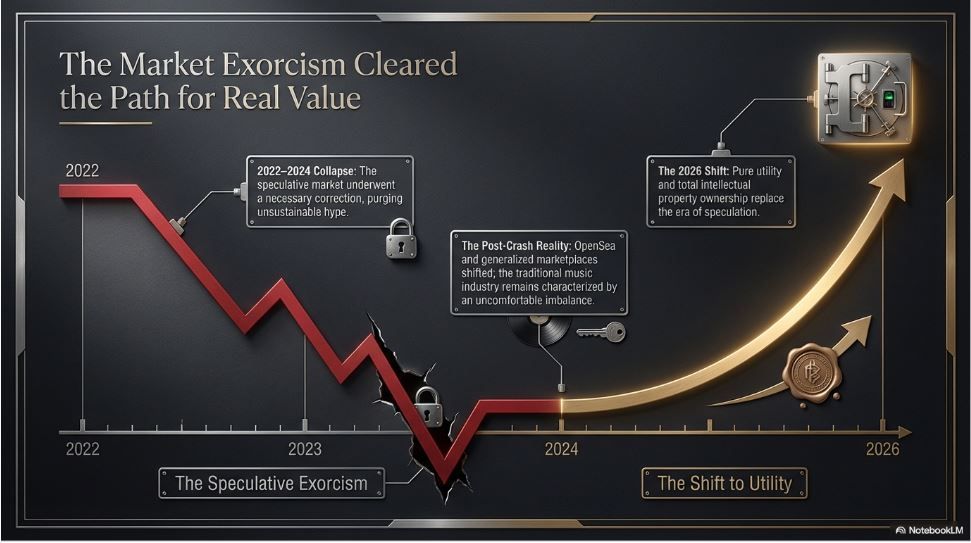
Between 2022 and 2024, the market that had generated billions in trading volume — JPEGs selling for millions, profile pictures becoming status symbols, anonymous wallets outbidding institutional collectors — collapsed under the weight of its own speculation. Trading volume dropped 97% from its peak. Projects that had commanded six-figure floor prices became worthless. The obituaries were written. The critics were satisfied.
And then something quietly remarkable happened.
The noise left. And what remained was something far more interesting than anything the bubble had produced.
WHAT NFT 1.0 ACTUALLY WAS
To understand where we are going, it is worth being precise about where we have been.
NFT 1.0 was a static token. A digital certificate attached to a digital image. You owned the token. The image sat on a server somewhere. The value was entirely speculative — a function of community hype, celebrity endorsement, and the greater fool theory applied to blockchain technology.
There was no music. No story. No human voice behind the work. No artistic intention beyond the minting of the token itself. The art, in most cases, was algorithmically generated — thousands of slightly different variations of the same character, wearing different hats, assigned different background colors, priced according to rarity scores calculated by the same algorithm that created them.
It was, in retrospect, the first draft of an idea that hadn’t fully arrived yet.
That draft crashed. The idea survived.
NFT 2.0 — UTILITY CHANGES EVERYTHING
The NFT projects that survived the correction shared a single characteristic: they did something.
NFT 2.0 introduced the concept of utility — the idea that a token could be more than a certificate of ownership for a static image. Event access. Membership. Royalty participation. Dynamic metadata that changed based on real-world conditions. The token became an instrument rather than a receipt.
The music industry was slow to fully grasp this. A handful of artists experimented with NFT drops — some successfully, most not — but the prevailing model remained essentially NFT 1.0 thinking applied to audio files. Buy the token, own the song file, speculate on resale value. The human dimension of the music — the story behind the lyrics, the relationship between the artist and the work, the cultural context that gives a piece of music its meaning — was almost entirely absent from the transaction.
The collector was buying a file. Not an experience. Not a relationship. Not a piece of a human being’s creative life.
That is not what music is. And serious collectors — the kind who acquire cultural artifacts with the same intentionality they bring to fine art, rare books, or historical objects — understood this instinctively. They stayed away.
Until now.
MARIA MICCOLI AND THE WORK THAT CHANGES THE CONVERSATION
Maria Miccoli is a hearing impaired poet, songwriter, and visual artist with a technology background whose work has arrived at a precise and historically significant moment.
The lyrics are hers. Written by hand, by a human being, shaped by the full weight of personal experience, emotional intelligence, and the particular kind of truth that only emerges when a poet decides to stop protecting herself and start telling the actual story. These are not generated words. They are not assembled from patterns in a training dataset. They are the product of a singular human consciousness, expressed in language that carries the specific gravity of lived experience.
The songs — AI-generated productions built around those human lyrics — represent something the music industry is only beginning to understand how to categorize. They are neither purely human nor purely artificial. They exist in a genuinely new space: human intention and emotion expressed through artificial execution. The lyrics set the soul of the work. The AI gives it a voice, a production, a sonic environment. The result is a collaboration between human creativity and machine capability that neither could have achieved independently.
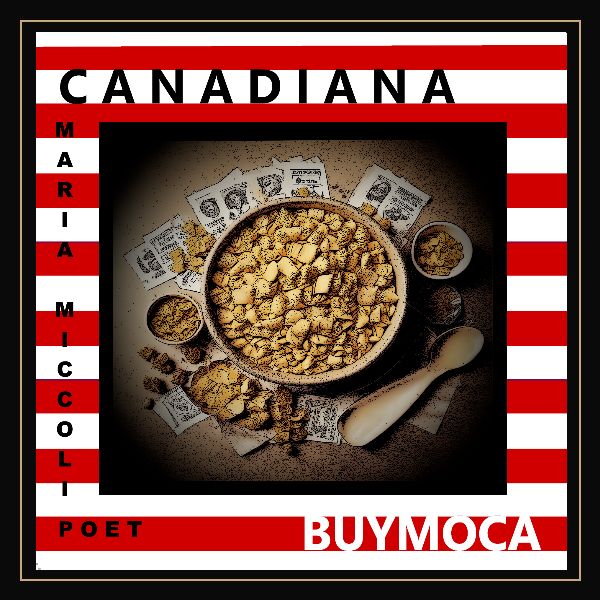
Each song in the collection has its own cover art, created by Maria Miccoli herself. Not commissioned. Not outsourced. Not generated. Created by the same hand that wrote the lyrics — a visual interpretation of the emotional world each song inhabits. The album’s visual identity is coherent, intentional, and inseparable from the music. Every piece of cover art was realized with the specific song in mind, matching what Miccoli describes as the soul of the overall album — the through-line of feeling and meaning that connects every track into a unified body of work.
What is being offered through closedbid.com/nft is not a file. It is not a token attached to a generated image. It is a complete cultural artifact: human lyrics, AI-realized music, original visual art, and the documented creative provenance of all three — authenticated, packaged, and offered through a sealed bid auction that ensures every bidder competes on equal terms with complete privacy.
THE NFT 3.0 BRIDGE — AND WHY THIS COLLECTION STANDS AT THE CROSSING
NFT 3.0 is emerging now. Its defining characteristic is intelligence — tokens that evolve, integrate with AI systems, carry programmable behaviors, and exist as living digital objects rather than static receipts. The technology is arriving in real time. Standards like ERC-7857 are enabling NFTs that can update their own attributes, link with external AI models, and operate across platforms simultaneously.
Maria Miccoli’s collection is not NFT 3.0. It is not making that claim. The technology that will define NFT 3.0 is still being written. She describes it as NFT 2.5.
But it stands precisely at the bridge between what NFT 2.0 made possible and what NFT 3.0 is becoming (She describes it as NFT 2.5) — for a specific and important reason.
The collection is human at its core and AI at its surface. The lyrics — the soul of the work — are irreducibly human. The production — the voice the work speaks in — is AI. This is not a compromise. It is a deliberate creative choice that mirrors, in artistic terms, exactly what NFT 3.0 represents technologically: the integration of human intention with artificial intelligence in a single, coherent, valuable object.
When NFT 3.0 fully arrives — when tokens routinely carry AI capabilities, evolve in response to their owners, and operate as intelligent digital entities — the cultural artifacts that will carry the most value will be the ones that documented the crossing point. The works that existed at the exact moment human creativity and artificial intelligence first learned to collaborate at the level of genuine art.
This collection is that documentation.
THE TRANSACTION MODEL — A SEALED BID FIRST
closedbid.com is the auction platform of The Miccoli Group — a sealed bid environment where every qualified buyer submits a single private offer, no competing bids are visible, and the transaction closes on merit rather than competitive psychology.
For this collection, the bid structure is specific and deliberate:
50% of every bid is submitted in Bitcoin. 50% is submitted in cash at the equivalent Bitcoin value at time of auction close. Only whole Bitcoin amounts are permitted. The reserve is a minimum of 1 Bitcoin plus its cash equivalent — meaning the minimum realized value of any transaction tracks Bitcoin’s market price automatically.
A bid of 1 Bitcoin at $60,000 per Bitcoin represents a total transaction value of $120,000. A bid of 2 Bitcoin at the same price represents $240,000. The increments are clean, unambiguous, and significant enough to ensure that every bidder is a serious collector.
This structure exists for several reasons. The crypto component situates the transaction authentically within the NFT ecosystem — this is not a traditional art sale dressed in blockchain language. The cash component provides a stable, fiat-denominated anchor that serious collectors and their advisors can underwrite with confidence. The whole Bitcoin requirement eliminates friction and speculation in the bid increments. And the sealed bid format means that no bidder ever knows what anyone else has submitted — the price paid reflects genuine assessed value, not the outcome of competitive escalation.
There is no comparable transaction structure for music NFTs anywhere in the current market. This is, to The Miccoli Group’s knowledge, the first sealed bid Bitcoin/cash hybrid auction for an authenticated music and visual art NFT collection.
WHY INVESTORS AND MEDIA SHOULD PAY ATTENTION
The NFT market that collapsed was built on speculation divorced from substance. What is being built at closedbid.com/nft is the opposite — a transaction platform for cultural artifacts with documented human provenance, a clear creative vision, a novel transaction model, and a collection that sits at a historically significant moment in the convergence of human creativity and artificial intelligence.
The Miccoli Group’s position is straightforward: the works have value because they are genuinely valuable. The lyrics carry the weight of human experience. The visual art carries the signature of the human hand that made it. The AI production carries the technical sophistication of the most advanced music generation systems available. The collection as a whole carries the distinction of being among the first authenticated bodies of work to exist at the intersection of all three.
That is not a speculative position. It is a descriptive one.
For investors evaluating the closedbid.com/nft vertical as a platform asset — and for media covering the moment the NFT market reinvented itself — the Maria Miccoli collection is the case study worth understanding now, before the conversation catches up to what is already here.
THE COLLECTION IS AVAILABLE EXCLUSIVELY THROUGH closedbid.com/nft
Bids are sealed. Privacy is structural. The reserve is 1 Bitcoin plus its cash equivalent.
The Miccoli Group accepts bids from verified collectors only. All transactions comply with applicable FINTRAC financial integrity requirements. Buyer privacy from other market participants does not imply privacy from regulatory or law enforcement authorities.
This is human art. AI voice. Sealed bid. Bitcoin and cash.
Welcome to the bridge.
About The Miccoli Group
Maria Miccoli is also the CEO of The Miccoli Group. The Miccoli Group (TheMiccoliGroup.com) is the company behind closedbid.com — a sealed bid auction platform serving verified buyers and certified sellers across luxury assets, digital collectibles, and high-value transactions. nft.closedbid.com is the platform’s dedicated vertical for authenticated music and digital art NFTs. For media inquiries and collector registration visit Closedbid.com/NFT/Contact .