
Why the Most Important Music NFT of 2026 is a “Bridge” You Can’t See Yet
The NFT market didn’t just crash between 2022 and 2024; it underwent a necessary exorcism. The “speculative fever dream” that fueled billion-dollar profile pictures and celebrity-endorsed JPEGs collapsed under the weight of its own hollowness, with trading volumes plummeting 97% from their peak. As the critics wrote their obituaries for the technology, they missed the most important development: the noise was finally clearing to make way for substance. What is emerging now is a quiet, remarkable shift away from technological adolescence toward a sophisticated era of digital assets defined by human intentionality and long-term cultural value.
NFT 1.0 Was a “First Draft” Without a Soul
In retrospect, the first generation of NFTs was a functional manifestation of the “greater fool theory.” These were static tokens—digital receipts for files hosted on external servers—where the value was untethered from the art itself. The market was obsessed with rarity scores calculated by the same algorithms that generated the art: thousands of variations of characters wearing different hats or sunglasses, designed for high-frequency trading rather than aesthetic resonance. There was no story, no human voice, and no artistic intention beyond the minting process.
Serious collectors and institutional curators stayed away because they understood what the speculators did not: music and art are not just “files.” They are experiences rooted in a relationship with a creator’s life. NFT 1.0 offered a certificate of ownership, but it failed to capture a single shred of the human dimension.
Reflection: For the sophisticated investor, the “music files” of the 2021 era were a cautionary tale. Without the weight of a human being’s creative life behind the work, a digital asset is merely speculative noise. A true cultural artifact requires a through-line of feeling that a rarity algorithm can never replicate.
The Maria A. Miccoli Model—Human Soul, AI Voice
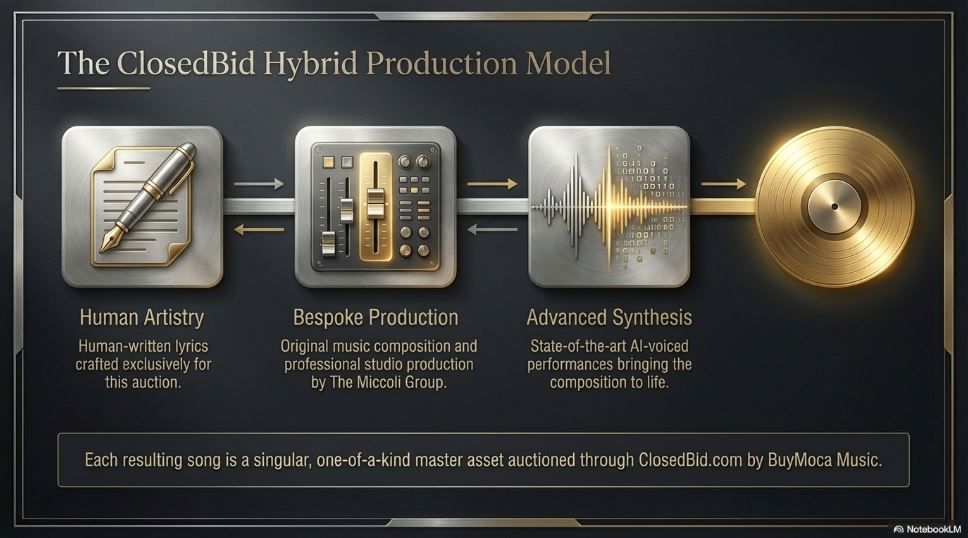
Maria A. Miccoli—a poet, songwriter, and visual artist—has introduced a creative architecture that provides the first viable blueprint for the post-hype era. Her collection is built on a “triple threat” of authenticity that anchors the technology in human vulnerability.
The foundation of the work is Miccoli’s lyrics. These are not phrases assembled from a training dataset; they are the particular kind of truth that only emerges when a poet decides to stop protecting herself and tell her actual story. While the music production is AI-generated, it serves as a collaborator rather than a replacement, providing a sonic environment specifically tailored to the soul of the lyrics. Completing the artifact is the original visual cover art, created by the same hand that wrote the lyrics, ensuring a coherent “through-line of feeling” across the entire body of work.
“Human intention and emotion expressed through artificial execution. The lyrics set the soul of the work. The AI gives it a voice, a production, a sonic environment.”
This model represents a radical departure from standard AI generation. It is human at its core and artificial at its surface, keeping human consciousness as the primary driver of the value.
We are Currently Crossing the “NFT 3.0 Bridge”
To understand why this collection matters in 2026, one must recognize the technological progression we are currently navigating. We are moving from the era of “Utility” to the era of “Intelligence.”
- NFT 1.0 (Static): A speculative receipt for a digital image.
- NFT 2.0 (Utility): Tokens as instruments—granting access, memberships, or royalty rights.
- NFT 3.0 (Intelligence): The era of “living digital objects.” Enabled by standards like ERC-7857, these tokens can update their own attributes and integrate with external AI models in real-time.
The Maria Miccoli collection does not claim to be NFT 3.0, but it is the essential bridge. The historical value of this work lies in its role as the documentation of the crossing point. In the future, when intelligent digital entities are commonplace, the most prized artifacts will be the ones that captured the exact moment human creativity and artificial intelligence first learned to collaborate as genuine art. This collection is the primary source material for that historical shift.
The End of Hype—The Sealed Bid Revolution
The shift toward substance is best exemplified by the transaction model hosted on closedbid.com. By moving away from public auctions, the platform eliminates the “competitive psychology” and emotional escalation that characterized the bubble years. This is the first sealed-bid Bitcoin/cash hybrid auction for an authenticated collection, designed to ensure that the transaction price reflects a genuine assessment of the art’s merit.
The auction requirements are precise, anchoring the sale in both the blockchain ecosystem and the stability of fiat:
- The 50/50 Dual-Currency Bid: 50% of the bid must be in Bitcoin, and 50% must be in cash at the equivalent Bitcoin value at the time of closing.
- Whole Bitcoin Increments: Only whole Bitcoin amounts are permitted (e.g., 1 BTC, 2 BTC), eliminating the friction of small-scale speculation.
- The 1 Bitcoin Reserve: The reserve is set at a minimum of 1 Bitcoin plus its cash equivalent. (For example, if BTC is at $60,000, the minimum realized transaction value is $120,000).
- Structural Privacy: Every qualified buyer submits a single private offer. No competing bids are visible, removing the “hype” from the price discovery process.
This structure allows serious collectors and their advisors to underwrite the investment with confidence, knowing the asset is situated within a professionalized financial framework.
The Documentation of the Moment
We have reached the end of speculation divorced from substance. The Maria Miccoli collection is a documented cultural artifact, a rare instance where the provenance of the lyrics, the visual art, and the AI production are authenticated as a single, unified vision.
As a strategist, I view this not just as a music release, but as the documentation of a historical pivot point. The market is no longer interested in “files” to trade; it is seeking a relationship with the future of art. For the serious collector, the choice is clear: you can either chase the remnants of speculative noise, or you can secure the documented provenance of the moment the bridge was finally crossed.
The question is no longer about what the technology can do, but about what the human spirit chooses to do with it. Are you looking for a file, or are you looking for the future?


