
From Boardroom to Tarmac — The CEO’s Guide to Private Aviation
Published by ClosedBid.com/air | The Premier Sealed-Bid Marketplace for Private Jets, Airplanes & Helicopters
The Sky Is Not the Limit — It’s the Launchpad
In today’s hyper-competitive global economy, a CEO’s most finite and irreplaceable resource is not capital, talent, or market share — it is time. Every hour lost to commercial airport queues, delayed connections, and middle-seat frustrations is an hour subtracted from decisions that move companies forward.
Private aviation has moved well beyond the realm of extravagance. In 2025, the industry shattered every record ever set, reaching 3,878,836 global private jet flights — a 4.6% increase over 2024 and 34% above pre-pandemic levels. Among those surveyed, a remarkable 94% of regular private flyers cite time savings as their primary motivation for paying five figures per flight.
For the modern executive, this guide is your complete playbook — from understanding the aircraft landscape to navigating ownership models, due diligence, and the smartest way to acquire your aircraft through a sealed-bid auction.
Part I: Why Private Aviation Is a Strategic Business Tool
Time Is the Asset
The arithmetic is simple. A group of four executives flying private on a round trip can expect to pay approximately $6,700 USD per person — a cost that, when measured against first-class commercial fares and the lost productivity of four senior leaders, frequently delivers a compelling return on investment.
Beyond economics, consider what private aviation actually unlocks:
Superior Time Efficiency — Private aircraft access over 5,000 airports in the US alone, compared to the roughly 500 served commercially. Landing at a smaller regional airfield can shave hours off a door-to-door journey. You arrive 15 minutes before departure, not two hours.
Airborne Productivity — The cabin becomes your conference room. Wi-Fi-equipped aircraft allow uninterrupted virtual meetings, deal reviews, and strategy sessions at 45,000 feet. Unlike commercial cabins — where sensitive conversations carry risk — the private cabin is your boardroom with wings.
Privacy & Confidentiality — M&A discussions, investor calls, and proprietary strategy sessions require confidentiality. The private jet cabin is, functionally, the most secure meeting room you will ever occupy.
Geographic Flexibility — Last-minute schedule changes, emergency site visits, and international market entries become frictionless. Private aviation operates on your schedule, not an airline’s hub-and-spoke timetable.
Reduced Executive Fatigue — Arriving at a critical negotiation rested, composed, and focused rather than crumpled and jet-lagged from a red-eye is not a luxury — it is a performance advantage.
Part II: The Aviation Landscape — Know Your Aircraft
The world of private aviation is far more stratified than most first-time buyers realize. Choosing the wrong category of aircraft for your travel profile is one of the costliest mistakes an executive can make.
Light Jets — The Agile Workhorse
Light jets are the most widely flown aircraft in private aviation, accounting for 43.6% of all global private jet flights in 2025. They are purpose-built for regional travel, typically carrying 6–8 passengers across distances of 1,500–2,500 nautical miles.
| Attribute | Detail |
|---|---|
| Passenger Capacity | 6–8 |
| Range | 1,500–2,500 nm |
| Ideal For | Regional hops, day trips, domestic routes |
| Example Models | Citation CJ4, Phenom 300E, HondaJet Elite II |
| Price Range (Pre-Owned) | $3M–$12M |
Best For: CEOs who primarily fly domestic corridors and want a cost-effective, nimble option that accesses small regional airports.
Midsize & Super-Midsize Jets — The Executive Sweet Spot
This category represents the most popular segment for corporate flight departments. Super-midsize jets bridge the gap between range and cabin comfort — capable of transatlantic legs without the overhead of an ultra-long-range aircraft.
| Attribute | Detail |
|---|---|
| Passenger Capacity | 8–10 |
| Range | 3,500–4,500 nm |
| Ideal For | Cross-country, transatlantic, multi-city tours |
| Example Models | Embraer Praetor 600, Citation Longitude, Challenger 350 |
| Price Range (Pre-Owned) | $10M–$28M |
The Embraer Praetor 600, for instance, delivers a best-in-class cabin altitude for reduced passenger fatigue — a clinically meaningful advantage on long hauls before critical business engagements.
Large Cabin & Ultra-Long-Range Jets — The Flying HQ
For global executives and multinational CEOs, large-cabin aircraft are the standard. These aircraft feature dedicated sleeping areas, full galleys, separate meeting zones, and intercontinental range that eliminates technical stops.
The Gulfstream G700 — the preferred flagship for Fortune 500 CEOs
| Attribute | Detail |
|---|---|
| Passenger Capacity | 10–19 |
| Range | 6,000–8,000+ nm |
| Ideal For | Intercontinental, non-stop global routes |
| Example Models | Gulfstream G700, Bombardier Global 7500, Dassault Falcon 8X |
| Price Range (New) | $65M–$120M+ |
The Gulfstream G700 offers a 7,500-nautical-mile range at Mach 0.90 — flying non-stop from New York to Dubai with ease — while its “Symmetry Flight Deck” represents the pinnacle of modern avionics. The Bombardier Global 7500 counters with four discrete living spaces, a master suite with a full-size bed, and the longest range in business aviation at 7,700 nm.
Ultra-long-haul flights have surged 56% since 2019, underscoring that global executives are increasingly demanding intercontinental, non-stop capability.
Helicopters — The First and Last Mile Solved
Often the overlooked dimension of a complete private aviation strategy, executive helicopters are the connective tissue of a seamless journey. They eliminate the costly ground transfer between city centre and airport, provide access to remote sites, superyacht pads, and ski resorts, and can serve as standalone city-hopper solutions.
Top-tier executive helicopters rival private jets for cabin refinement
| Aircraft | Capacity | Range | Best For |
|---|---|---|---|
| Sikorsky S-76D | 12 | 400 nm | VIP corporate transport |
| AgustaWestland AW139 | 15 | 573 nm | Long-distance city hops |
| Leonardo AW609 TiltRotor | 9 | 700+ nm | STOL missions, remote access |
| Airbus H175 | 16 | 450 nm | Offshore, remote, VIP |
The 2025 helicopter market saw supply tighten by 26% year-over-year while median transaction prices rose 5%, reflecting strong executive demand and constrained inventory — making early access to pre-owned helicopters via auction particularly valuable.
Part III: Ownership Models — Choosing Your Flight Profile
One of the most consequential decisions in private aviation is not which aircraft to acquire, but which acquisition model matches your utilization profile. Flying the wrong model can cost millions.
Full Ownership — Total Control, Total Cost
Full ownership is the ultimate expression of flexibility and brand. Your aircraft, your schedule, your crew, your configuration. It is also the most capital-intensive option and makes economic sense only above approximately 200–400 flight hours annually.
Pros: Unrestricted access, deep customization, asset (with depreciation potential), branding opportunity
Cons: High acquisition cost, ongoing fixed expenses ($500K–$4M+ annually), crew management, maintenance obligations
Fractional Ownership — Access Without Full Exposure
Fractional ownership allows you to purchase a defined share (typically 1/16th or more) of a specific aircraft or aircraft type, granting a corresponding annual hour allotment. Operators like NetJets, Flexjet, and PlaneSense manage the aircraft operationally.
Best For: Executives flying 50–200 hours annually who want guaranteed access without full ownership overhead.
Jet Cards — Simplicity at a Premium
Jet card programs lock in a fixed hourly rate for a pre-purchased block of hours, typically on a specific category of aircraft. They offer remarkable simplicity with no long-term capital commitment.
Best For: Executives flying under 50 hours per year or those supplementing existing ownership to cover peak demand periods.
Charter — The On-Demand Option
Charter means renting an aircraft for a specific trip with no long-term commitment. Charter and fractional operators now drive the majority of industry growth, with total flights 45.2% higher than 2019 levels.
Best For: Executives with unpredictable travel schedules or those evaluating whether ownership makes sense before committing.
Part IV: The Market in 2025 — What Every Buyer Must Know
The private aviation acquisition landscape in 2025 presents specific dynamics that every prospective buyer must understand before entering the market.
Record Demand, Constrained Supply
The global private jet market is projected to reach $39.84 billion in 2025, up from $25.87 billion in 2021. New aircraft backlogs at major OEMs — Gulfstream, Bombardier, Embraer, and Textron — extend 18 to 30 months for high-demand models. Meanwhile, the pre-owned market remains tight, with quality used jets commanding prices up to 10% above historical averages as owners retain aircraft during production delays.
A Globalizing Market
While the United States remains the dominant market at 67.9% of global departures, the highest growth rates are now emerging from Latin America (+11% YoY) and Africa (+15% YoY). European business jet activity has also surpassed pre-pandemic records. The global ultra-high-net-worth population continues to expand, broadening the buyer base internationally.
Sustainability as a Purchase Factor
Modern buyers are increasingly weighing Sustainable Aviation Fuel (SAF) compatibility, hybrid-electric propulsion roadmaps, and carbon offset programs as part of the acquisition decision. ESG-conscious boards are scrutinizing corporate flight departments, making sustainability credentials a boardroom consideration, not just a marketing one.
Tax Strategy Alignment
The 2025 fiscal environment in the United States has re-energized acquisition activity, with 100% bonus depreciation provisions allowing the full cost of a qualified aircraft purchase to be deducted from taxable income in the year of acquisition. Some transactions were strategically deferred into 2025 specifically to capture these benefits — a move that savvy CFOs should be modeling.
Part V: Due Diligence — Never Skip These Steps
Acquiring a private aircraft is unlike any other asset purchase. The consequences of shortcuts are expensive, potentially dangerous, and legally complex.
The Executive’s Due Diligence Checklist
1. Pre-Purchase Inspection (PPI)
Engage an independent, FAA-certified aviation maintenance technician who has no relationship to the seller. A thorough PPI examines airframe, engines, avionics, hydraulics, pressurization, and structural integrity. This is non-negotiable for any pre-owned acquisition.
2. Title & Lien Search
Verify ownership chain through the FAA Aircraft Registry and the International Registry (for aircraft with international mortgages). Undisclosed liens can transfer with aircraft ownership.
3. Maintenance Records Review
Request complete logbooks. Gaps in maintenance history, deferred airworthiness directives (ADs), or incomplete engine records are red flags that should either kill the deal or dramatically reprice it.
4. Engine & APU Status
Confirm enrollment status in Power-by-the-Hour (PBTH) or engine maintenance programs (e.g., JSSI, MSP, TAP). Engines not enrolled in a program carry materially higher operating cost exposure.
5. Configuration & Avionics Currency
Verify ADS-B Out compliance, FANS-1/A capabilities for international routing, and current avionics software versions. Upgrading non-compliant avionics can cost $200K–$500K+ post-acquisition.
6. Escrow & Closing
All funds should be held in a neutral escrow account. Release only upon satisfactory completion of the PPI and full title transfer confirmation. Use aviation-specialized legal counsel.
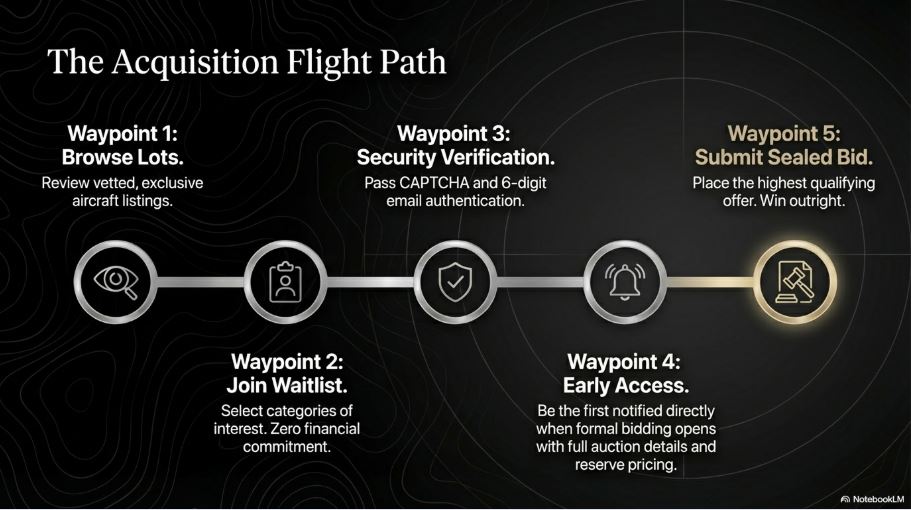
Part VI: Why a Sealed-Bid Auction Is the Smartest Way to Buy
The traditional private aviation acquisition process is inefficient, opaque, and frequently disadvantageous to both buyer and seller. Broker-to-broker negotiations are protracted. Pricing is obscured by asymmetric market information. Motivated sellers cannot efficiently signal their terms, and motivated buyers cannot efficiently signal their conviction.
The sealed-bid auction model changes this entirely.
How Sealed-Bid Auctions Work
In a sealed-bid auction, every qualified buyer submits their best and final offer in confidence, without knowledge of competing bids. The seller reviews all bids simultaneously and accepts or rejects at their discretion. There are no negotiating games, no bid escalation by competing parties, and no manufactured urgency by brokers.
Why It Benefits Buyers
- Price Discovery: You are bidding against the true market, not a broker’s artificial anchor
- Confidentiality: Your acquisition strategy and budget remain private from competitors
- Equal Access: Every buyer — whether first-time or institutional — receives identical information and an identical opportunity window
- Efficiency: Transactions that drag for months in traditional channels are resolved in days
Why It Benefits Sellers
- Maximized Value: Competitive tension among sealed bids drives prices to genuine market peaks
- Certainty of Process: The seller controls the timeline, terms, and reserve
- Qualified Pool: Auction platforms pre-qualify bidders, eliminating tire-kickers
ClosedBid.com/air is the first dedicated sealed-bid marketplace for private jets, airplanes, and helicopters — bringing the transparency and competitive efficiency of the auction model to an asset class that has long needed it. Join the waitlist.
Part VII: The Complete Cost of Ownership — What Your CFO Needs to See
Acquisition price is only the beginning. Any honest private aviation business case must account for the full economic picture.
| Cost Category | Annual Estimate (Midsize Jet) |
|---|---|
| Crew Salaries & Benefits | $300,000 – $600,000 |
| Fuel | $400,000 – $900,000 |
| Maintenance & MRO | $200,000 – $500,000 |
| Hangar & Storage | $60,000 – $200,000 |
| Insurance | $50,000 – $150,000 |
| Management Fees | $80,000 – $150,000 |
| Navigation/Landing Fees | $30,000 – $80,000 |
| Total Annual Fixed Costs | ~$1.1M – $2.6M |
These figures scale significantly for large-cabin and ultra-long-range aircraft, where all-in annual operating costs can exceed $4–8 million. For executives flying fewer than 200 hours per year, the per-hour economics of fractional ownership or jet cards often prove superior to full ownership — until utilization justifies the upgrade.
Part VIII: The Future of Executive Aviation
The private aviation market is not standing still. Five forces are reshaping the landscape for the CEOs who will be making acquisition decisions over the next five years:
1. Electric & Hybrid Propulsion
Short-range electric aircraft (eVTOL and conventional electric) will begin to enter the executive transport market in earnest by 2027–2029. Urban Air Mobility — flying between helipads and city vertiports without a pilot in some configurations — is no longer science fiction.
2. Supersonic Business Jets
Boom Supersonic and Aerion (in various iterations) continue to develop aircraft that will compress transatlantic flight times by 40–50%. The CEO who boards a London-to-New York flight in under four hours is a decade, perhaps less, away.
3. AI-Powered Flight Operations
From AI-assisted maintenance scheduling to predictive fuel optimization and real-time route planning, technology is reducing operating costs and enhancing safety across the fleet.
4. Sustainable Aviation Fuel (SAF)
SAF adoption is accelerating. Corporate travel policies and board-level ESG mandates are pushing flight departments toward SAF-capable aircraft and verifiable offset programs as standard operating procedure.
5. Digital Marketplace Platforms
The era of informal, relationship-driven aircraft transactions is giving way to structured, data-rich digital platforms — of which ClosedBid.com/air represents the next evolution: transparent, sealed-bid, and accessible globally.
The Final Approach
Private aviation is not a perk. It is a precision instrument for executive performance — and like any precision instrument, it rewards those who understand it deeply before deploying it.
The executives who are winning in 2026 and beyond are not simply buying aircraft. They are constructing aviation strategies that align utilization, cost, flexibility, and sustainability with their business objectives. They are leveraging tools like sealed-bid auctions to acquire aircraft at genuine market value without the opacity of traditional brokerage. And they are treating every hour in the air as a boardroom opportunity, not dead time.
Whether you are a first-time buyer evaluating a light jet, a CFO modeling the fractional versus ownership decision, or a global CEO searching for a flagship large-cabin aircraft — the runway to your ideal aviation solution begins at:
ClosedBid.com/air
The Sealed-Bid Marketplace for Private Jets, Airplanes & Helicopters
Browse current auction listings. Submit sealed bids. Acquire with confidence.
This article is produced by ClosedBid.com/air for informational purposes. Market data referenced reflects 2025 industry figures. Prospective buyers should consult qualified aviation attorneys, tax advisors, and certified aircraft appraisers before any transaction.
About The Miccoli Group
Maria Miccoli is also the CEO and Editor-In-Chief of TheMiccoliGroup.com and the company behind closedbid.com/air — a sealed bid acquisition intelligence platform for private jets, corporate jets, and
helicopters. The sealed bid auction platform air.closedbid.com is a dedicated vertical for private and corporate jets, helicopters and other aviation vehicles. For media inquiries and broker or buyer registration visit Closedbid.com/Air/Contact .


